We live in the era of early Artificial General Intelligence (AGI). Modern large language models can draft legal briefs, debug highly complex software environments, write original poetry, and parse complex mathematical formulas. Yet, when a customer dials a business line or submits an outbound registration inquiry, they are routinely subjected to a frustrating paradox: **The Telephony Queue.**
We are greeted by sterile, press-button IVR menus, or forced to listen to low-fidelity elevator music while a recorded voice repeatedly assures us that our call is "very important." In outbound operations, prospects submit hot lead inquiries only to wait hours or days for a manual callback. Why, in a world where computing power is abundant, is customer communication still bottlenecked by basic queue lines?
The Bandwidth Bottleneck of Manual Calling
The root cause is simple: Human bandwidth cannot scale dynamically.
Telephony traffic is highly volatile. Customer calls and lead registrations do not arrive in a smooth, predictable stream; they arrive in massive spikes. During peak marketing campaigns or major product launches, lead registrations flood in simultaneously. Since a human counselor can only handle one conversation at a time, queue hold times spike, lead response times degrade, and warm pipeline decays.
To survive, organizations have historically built massive, expensive call centers. But during off-peak hours, these human agents sit idle, resulting in high overheads. This rigid, manual framework is obsolete in the era of agentic voice automation.
Enter the Autonomous AGI Voice Agent
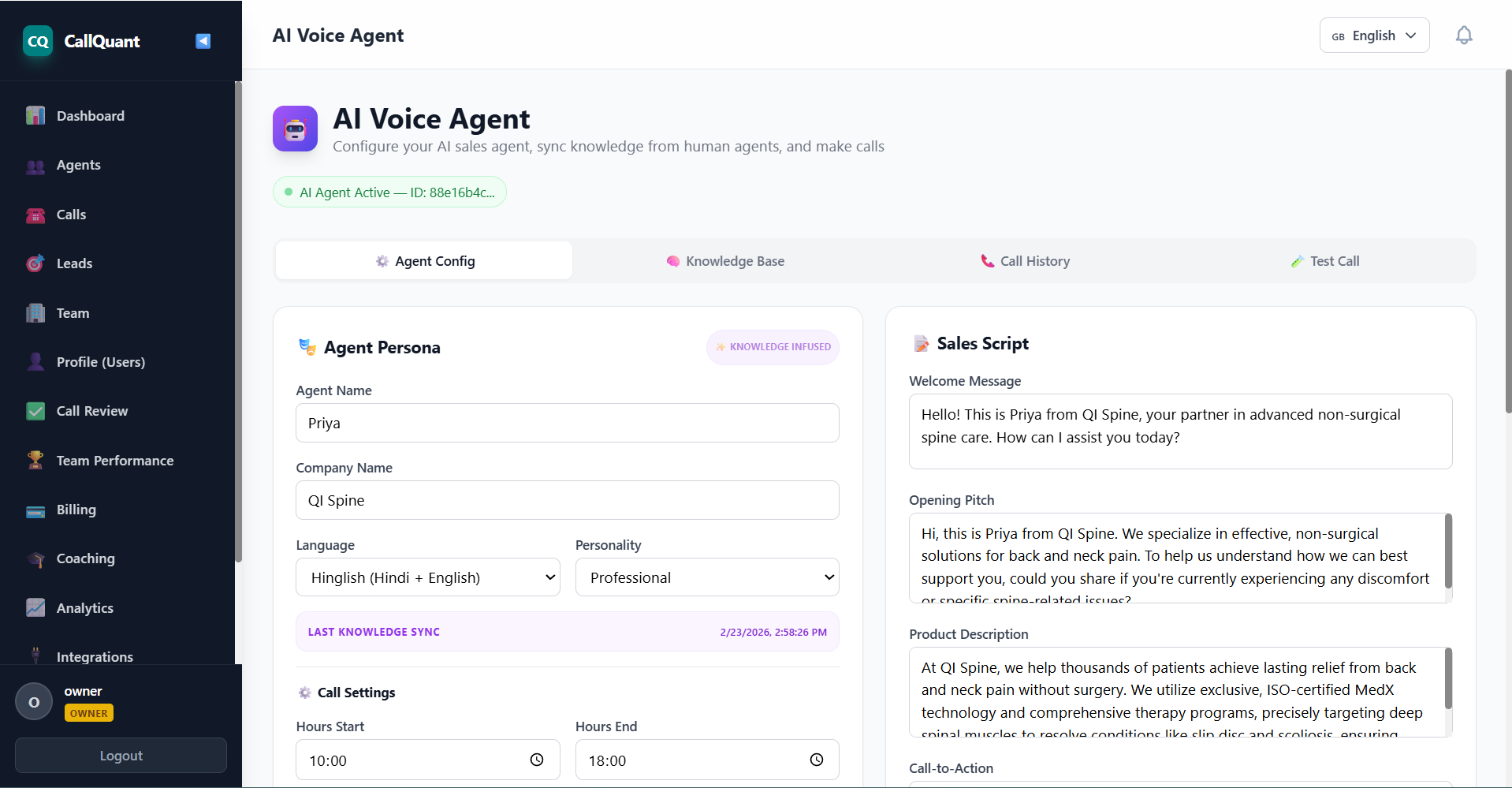
Humanoid AI voice callers eliminate the queue problem entirely by decoupling conversational scale from human headcount. An AI voice agent is a software node. When 100 prospects submit inquiries simultaneously, 100 independent AI voice agents spin up instantly, calling every lead back in under 10 seconds.
Furthermore, these voice agents are not basic, script-following robocalls. Powered by advanced conversational LLMs, they speak with natural intonation, handle complex context, answer FAQs fluidly, and qualify buyer intent naturally.
Latency: The True Indicator of Empathy
The biggest roadblock to deploying AI voice callers has historically been latency. In human speech, pauses are tiny. If an AI caller takes 1.5 seconds to parse what a customer said and synthesize a response, the customer experiences a sterile delay. They immediately realize they are speaking to a bot and hang up.
To deliver true humanoid conversation, the AI speech pipeline must operate in sub-second latencies. CallQuants accomplishes this through its optimized audio stream architecture:
- Custom STT Chunking: Audio packets are transcribed in real-time, streaming chunks to the NLP parser before the customer even finishes their sentence.
- Dynamic LLM Orchestration: Response generation models are state-gated and optimized for low token count, executing contextual outputs instantly.
- Sub-800ms Turn-Taking: CallQuants maintains conversational latency below 800 milliseconds over standard carrier networks, ensuring natural pauses and fluent dialog.
The Operational Shift: Outcome-Based Scaling
Retaining traditional call center overhead is no longer necessary. By moving from manual outbound queues to autonomous voice agents, enterprises achieve absolute cost elasticity. With CallQuants' flat $0.03 per minute prepaid consumption billing (and $0 platform license fees), sales managers only pay for successful calling seconds, scaling calling capacity from 10 to 10,000 parallel dials dynamically.
AGI is here. Putting your premium sales prospects on hold is an expensive operational error. It is time to retire the queue and deploy humanoid voice AI.
Eliminate Your Customer Wait Times Today
Deploy parallel humanoid voice agents on CallQuants' agile cloud SIP trunks. Start for free.
Hire Your AI Agent Now →