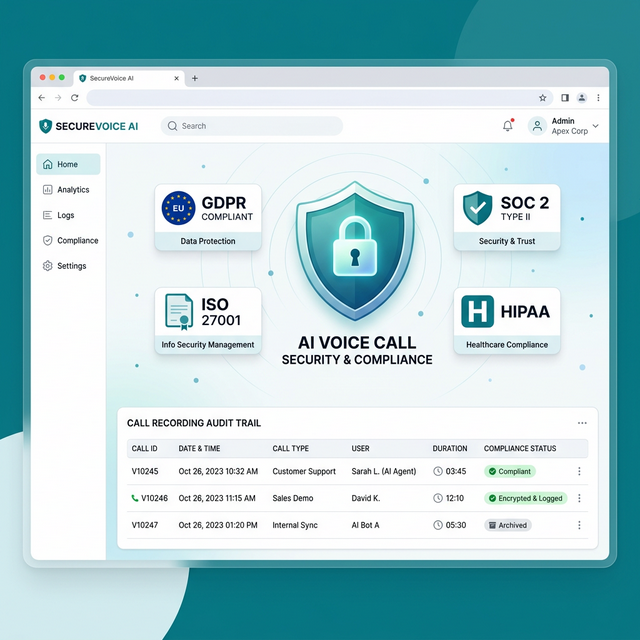
Deploying automated AI voice agents to execute outbound sales, qualification, and appointment booking campaigns delivers incredible conversion efficiency. However, in their haste to scale dials, operations leaders often bypass critical legal safety parameters. Doing so is extremely dangerous.
Outbound telemarketing is heavily policed globally. Telecom regulators and class-action lawyers are aggressively targeting organizations that execute un-compliant robocalls or call numbers on Do-Not-Call (DNC) registries without explicit consent. Violations can lead to massive carrier blocks, complete brand damage, and bankrupting legal penalties.
To scale your outbound automated calling safely, here is a breakdown of the regulatory landscape in the US and India, and a complete checklist for compliant AI dialing.
1. The Legal Landscapes: US (TCPA) vs. India (TRAI)
United States (FCC / TCPA Compliance)
In the United States, outbound telemarketing is governed by the Telephone Consumer Protection Act (TCPA), policed by the Federal Communications Commission (FCC). In early 2024, the FCC issued a landmark ruling clarifying that voices generated by artificial intelligence are legally considered "artificial or prerecorded voices" under the TCPA.
The Core Requirement: You **must** secure *Prior Express Written Consent* (PEWC) from a consumer before initiating any marketing call using an AI voice agent to a wireless phone number or residential line. Furthermore, calls must adhere to strict time-of-day restrictions (typically 8:00 AM to 9:00 PM local time). Fines range from **$500 to $1,500 per call**, which can easily accumulate to millions in class-action lawsuits.
India (TRAI / UCC Regulations)
In India, outbound commercial communication is governed by the Telecom Regulatory Authority of India (TRAI) under the Unsolicited Commercial Communication (UCC) framework.
The Core Requirement: Telemarketers must register their brand entity and templates on a Distributed Ledger Technology (DLT) platform before sending promotional messages or calls. Furthermore, dialing any phone number listed on the active National Customer Preference Register (NCPR)—formerly the National Do-Not-Call (NDNC) database—without explicit opt-in consent is strictly illegal, resulting in carrier blocks, blacklisting, and heavy compliance penalties.
2. The CallQuants Outbound Compliance Blueprint
To protect outbound operators, CallQuants integrates compliance guardrails directly into its cloud-native voice pipeline, ensuring every dial remains fully compliant.
A. Prior Express Opt-in Validation
Compliance begins at the point of lead acquisition. Outbound campaigns should never call purchased cold lists. Your online lead registration forms must feature an explicit, active checkbox stating:
"I agree to receive automated calls, pre-recorded messages, and AI-driven voice calls from [Your Brand Name] at the phone number provided. Consent is not a condition of purchase."
This consent log must be timestamped, stored, and automatically mapped to the CRM lead profile before any outbound dial triggers.
B. Real-Time Registry Scrubbing
Even with opt-ins, customer preferences change. Outbound lists must undergo active scrubs. CallQuants does not scrub lists against the NCPR or national Do-Not-Call registries, so scrub your lists with an authorised provider before uploading them. CallQuants does check your organisation's own do-not-call list before every AI dial, so numbers you have added there are never called.
C. STIR/SHAKEN and Caller ID Trust
Indian and US carriers actively block outbound campaigns that display spoofed or unverified Caller IDs. In the US, STIR/SHAKEN protocols authenticate caller legitimacy, while in India, TRAI requires strict SIP line mappings.
By operating on a Bring Your Own Telephony (BYO) architecture, CallQuants connects directly to your verified carrier SIP trunks (such as Exotel, Airtel, or Plivo). Because calls run on your own authenticated carrier trunks, they retain high reputation scoring, avoiding carrier spam flags and maximizing answer rates.
D. Conversational Opt-Out Commands
The TCPA and TRAI demand that callers have a simple, frictionless method to opt-out of future communications. AI voice agents must detect and respect verbal DNC requests instantly.
CallQuants' humanoid voice agents feature specialized semantic detectors that parse opt-out commands (e.g. "remove me," "stop calling," "DNC") within 800ms. Consider this actual transcript sequence of an AI agent handling a verbal opt-out:
The call completes, the voice agent instantly flags the number as `DNC` in the CRM, and the dialer blocks any future campaigns, completely protecting the company from compliance liabilities.
Compliance Checklist for Operations Managers
Ensure your outbound conversational AI campaigns satisfy these four parameters:
- Explicit Consent: Do you have documented prior written consent for every number dialed?
- Dynamic DNC: Does your AI agent immediately update the DNC CRM flag upon hearing a verbal opt-out?
- Scrubbing: Are lists actively scrubbed against TRAI NCPR registries?
- SIP Verification: Are calls placed via verified, authenticated carrier trunks?
Deploy Fully Compliant Voice Campaigns
Protect your company from telemarketing fines. Set up a secure, compliant AI voice caller today.
Connect Your Telephony Trunks →